

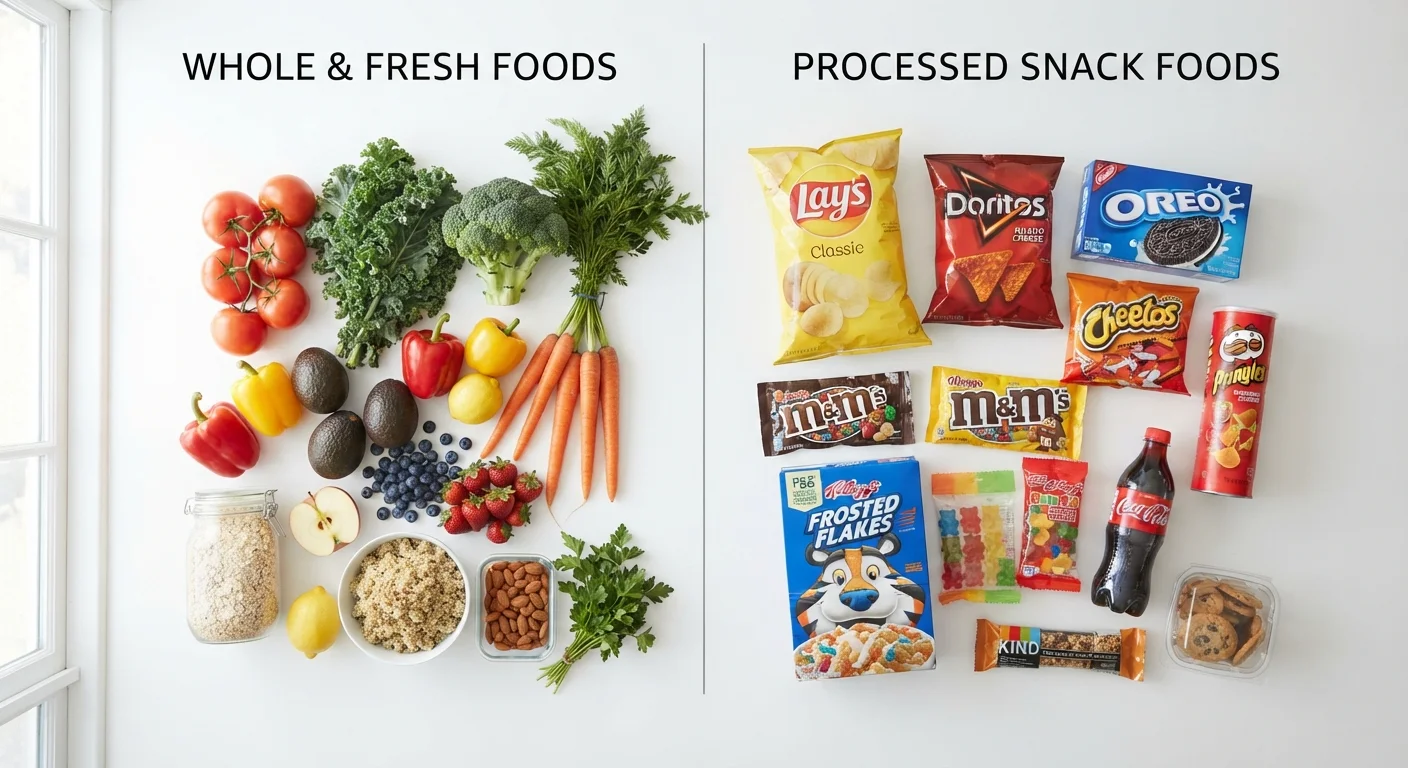
Option A
Whole Foods
Foods in their most natural, unaltered state.
Best for: People looking to maximize nutrient density and minimize additives in their diet.
Option B
Processed Foods
Foods that have been altered from their original form in some way.
Best for: Busy households seeking convenient, shelf-stable options — though the degree of processing matters greatly.
What 'Whole Food' Actually Means
The term whole food refers to any food consumed in — or very close to — its natural, unrefined state. Think fresh apples, dry lentils, brown rice, raw nuts, or a chicken breast with no added marinades or preservatives. The key characteristic is that nothing significant has been removed or added.
Whole foods naturally retain their full complement of nutrients: fiber, vitamins, minerals, and various plant compounds called phytonutrients. Research consistently associates diets built around whole foods with lower rates of chronic diseases including cardiovascular disease and type 2 diabetes. Part of the reason may be what nutritionists call the food matrix — the physical structure that keeps nutrients bundled together and may influence how the body absorbs and uses them.
It's worth noting that "whole food" isn't a regulated label term in the U.S., so it describes a concept rather than a certified standard. For a deeper look at where this line actually falls, see where the line actually falls.
Processing Is a Spectrum, Not a Binary
Here's where most diet conversations go wrong: they treat "processed" as a single category. In reality, food processing ranges from trivially simple to highly industrial. Washing and bagging spinach is processing. So is engineering a snack cake with 40 ingredients. Lumping them together creates more confusion than clarity.
A widely used framework developed by Brazilian researchers — the NOVA classification system — sorts foods into four groups based on the extent and purpose of processing:
- Group 1 – Unprocessed or minimally processed: Fresh fruits, vegetables, plain meats, eggs, and legumes.
- Group 2 – Processed culinary ingredients: Olive oil, flour, butter, sugar — things used to prepare food rather than eaten alone.
- Group 3 – Processed foods: Canned vegetables, cheese, cured meats, and similar products made by adding salt, oil, sugar, or preservation techniques to Group 1 foods.
- Group 4 – Ultra-processed foods (UPFs): Industrial formulations that typically contain ingredients not found in a home kitchen — emulsifiers, artificial flavors, colorings, and preservatives — used to extend shelf life and enhance palatability.
The health research focuses most of its concern on Group 4. Studies have associated high UPF consumption with increased risk of obesity, cardiovascular disease, and depression, though the research is still evolving and causation is difficult to establish definitively.
| Criterion | Whole Foods | Processed Foods |
|---|---|---|
| Definition | Unaltered or minimally altered from natural state | Any food changed from its original form |
| Ingredient complexity | One ingredient (the food itself) | Ranges from a few to dozens of additives |
| Nutrient retention | Full natural nutrient matrix intact | Varies widely; may be reduced or fortified |
| Added sugars / sodium | None by definition | Often present; higher in ultra-processed |
| Shelf life | Typically short; requires refrigeration | Extended — sometimes years |
| Convenience | Requires prep time | High; ready-to-eat or quick to prepare |
| Cost | Variable; fresh produce can be expensive | Often lower cost per serving |
| Health research outlook | Consistently positive associations | Mixed; poor for ultra-processed, neutral for minimally processed |
Why Ultra-Processed Foods Deserve Extra Attention
Ultra-processed foods aren't just "a little bit processed." They're engineered products designed to be convenient, hyper-palatable, and shelf-stable — often at the expense of nutritional quality. Common examples include mass-produced packaged breads with long ingredient lists, most fast-food items, sugar-sweetened beverages, and flavored snack chips.
Several mechanisms may explain the health associations researchers have observed. UPFs tend to be energy-dense, high in added sugars and sodium, and low in fiber. Some researchers also hypothesize that certain additives or the disruption of food structure itself plays a role — though this remains an active area of study.
Understanding what's actually in a product requires looking past the front of the package. Front-of-package claims like "multigrain" or "made with real fruit" can be misleading. Instead, check the ingredient list — and knowing that ingredients are listed by weight tells you a lot about what you're actually eating.
57%
Share of U.S. calorie intake from ultra-processed foods
A study published in BMJ Open estimated that ultra-processed foods account for more than half of daily calories consumed by American adults.
4 groups
NOVA food processing classification tiers
The NOVA system, developed by researchers at the University of São Paulo, categorizes all foods by degree and purpose of industrial processing.
~10%
Higher all-cause mortality risk linked to UPF consumption
Multiple large observational studies have found associations between high ultra-processed food intake and elevated mortality risk, though causation has not been firmly established.
A Practical Way to Apply This in Everyday Life
You don't need to eliminate all processed food to eat well. A more useful goal is to understand what you're choosing and why. Here are some practical reference points:
- Frozen plain vegetables: Minimally processed, nutritionally comparable to fresh, and often more affordable.
- Canned beans (low-sodium or rinsed): A convenient whole-food-equivalent with strong nutritional credentials.
- Flavored yogurt with multiple sweeteners: Shifts toward ultra-processed territory — plain yogurt with added fruit is an easy swap.
- Whole-grain bread with a short ingredient list: A processed food that can still support a healthy diet.
The distinction between added and naturally occurring sugars is another layer worth understanding — our article on added sugar vs. natural sugar breaks that down clearly. When comparing two similar packaged products, see what to actually look for on nutrition labels for a structured approach.
This article provides general nutrition information and is not a substitute for personalized advice from a qualified healthcare or registered dietitian professional.
The content on this site is for informational purposes only and is not a substitute for professional advice. Always consult a qualified professional for guidance specific to your situation.