

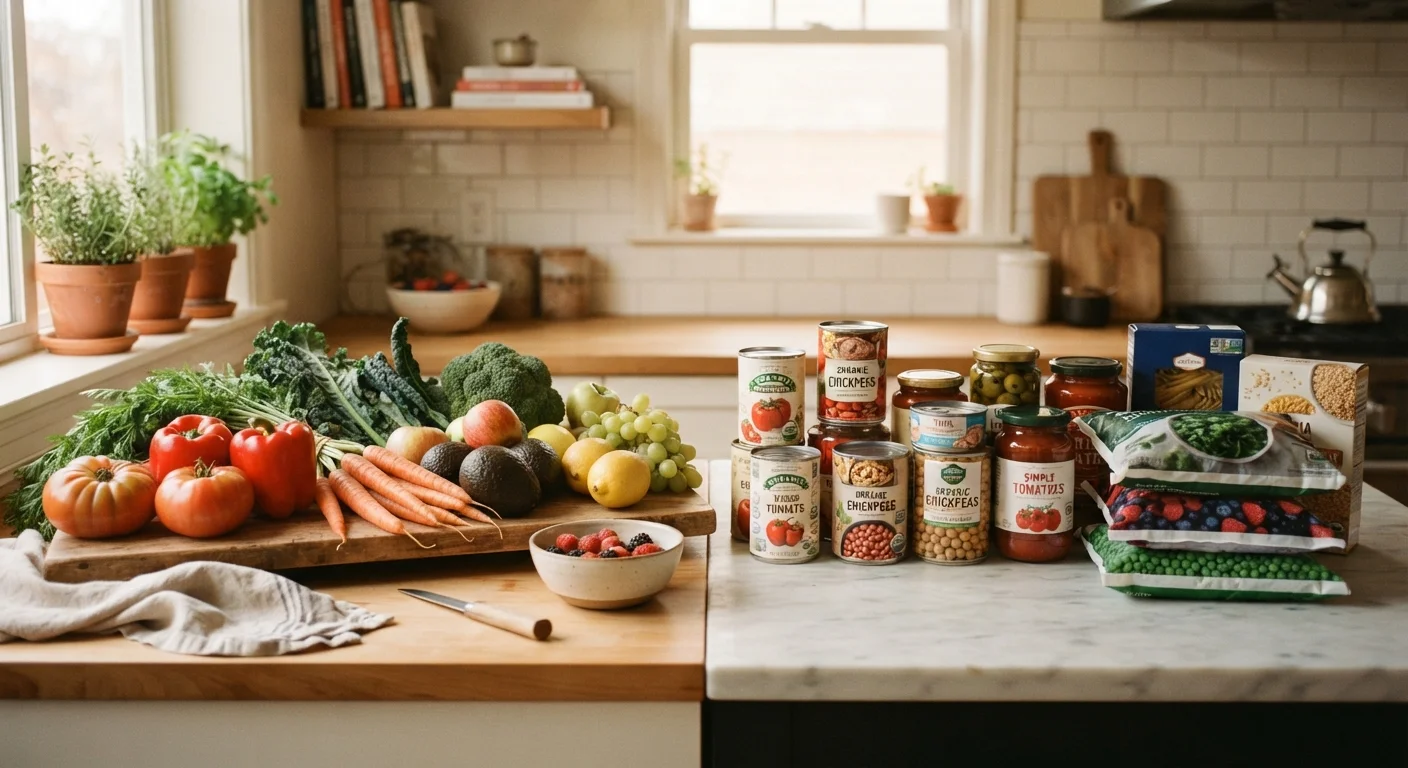
Option A
Whole Foods
Foods in or very close to their natural state.
Best for: People seeking maximum nutrient density with minimal additives in their everyday diet.
Option B
Processed Foods
Foods altered from their original form — ranging from minimally to heavily modified.
Best for: Anyone navigating convenience, shelf life, or budget constraints who still wants to make informed choices.
Why the Whole vs. Processed Distinction Isn't Black and White
Most people picture "whole food" as a raw apple and "processed food" as a bag of chips — and that contrast is real. But the full picture is more nuanced, and understanding it matters for making sensible, sustainable choices at the grocery store.
The term whole food refers to food that is eaten in or very close to its natural state: fresh fruit, vegetables, legumes, whole grains, eggs, and plain meat or fish. Nothing significant has been added or removed. What you see is, essentially, what the plant or animal produced.
Processed food, on the other hand, covers an enormous range. By the broadest definition, almost every food humans eat has been processed in some way — washed, cut, cooked, fermented, or packaged. That definition alone tells you very little about nutritional quality.
Nutrition researchers commonly use the NOVA classification, a framework developed by researchers at the University of São Paulo, which groups foods into four categories based on the degree and purpose of processing — from unprocessed or minimally processed foods all the way to ultra-processed formulations. Understanding where foods fall on that spectrum is far more useful than a simple whole/processed binary. For a deeper look at that spectrum, see Whole Foods vs. Processed Foods: Understanding the Real Difference.
| Criterion | Whole Foods | Processed Foods |
|---|---|---|
| Definition | Unaltered or minimally altered from natural state | Modified from original form in some way |
| Examples | Fresh apple, raw oats, plain chicken breast | Canned soup, frozen pizza, plain yogurt |
| Fiber retention | Fully intact | Varies — often reduced in ultra-processed forms |
| Added sugars/sodium | None | Ranges from none to very high |
| Shelf life | Short — requires refrigeration or prompt use | Extended — often months to years |
| Convenience | Requires more preparation | Generally quicker to prepare or eat |
| Nutrient density | Typically high | Highly variable by product |
What Happens Nutritionally During Processing
Processing can affect food in both directions — sometimes reducing nutritional value, sometimes preserving or even enhancing it.
On the negative side, heavy processing often strips away fiber (refining whole wheat into white flour removes the bran and germ), reduces heat-sensitive vitamins like B vitamins and vitamin C, and introduces substantial amounts of added sugars, sodium, and refined fats. These changes are most pronounced in ultra-processed products — think packaged snacks, sugary cereals, and fast-food items engineered for palatability and long shelf life.
On the positive side, minimal processing can make certain foods more accessible nutritionally. Freezing vegetables shortly after harvest locks in vitamins that would otherwise degrade during transit. Canning tomatoes concentrates lycopene, an antioxidant. Fermenting dairy into yogurt increases beneficial bacteria and makes lactose easier to digest for some people.
57%
Share of U.S. calories from ultra-processed foods
Research published in BMJ Open estimated that ultra-processed foods account for roughly 57% of daily caloric intake among U.S. adults.
28%
Higher added sugar intake from ultra-processed foods
The same BMJ Open analysis found that ultra-processed foods contributed about 90% of the added sugars consumed by U.S. adults in the study.
The practical upshot: the ingredient list is your best diagnostic tool. A short list of recognizable ingredients generally signals minimal processing. A long list dense with additives, emulsifiers, artificial flavors, and multiple forms of sugar signals heavy processing — the kind worth limiting. Our guide to Understanding Food Labels From Start to Finish walks through exactly how to read those lists clearly.
Practical Rules for Navigating Both Categories
Rather than eliminating all processed food — an impractical goal for most households — the goal is to identify where your diet sits on the processing spectrum and make targeted shifts.
- Default to minimally processed staples. Plain rolled oats, frozen vegetables with no added sauce, plain canned beans rinsed of excess sodium, and unsalted nuts are all technically processed but nutritionally strong.
- Treat ultra-processed foods as occasional, not foundational. Research consistently associates high ultra-processed food consumption with increased risk of various chronic conditions, though dietary patterns as a whole — not single foods — determine health outcomes.
- Don't mistake packaging for processing level. A bagged salad mix is minimally processed. A "multigrain" cracker with 15 ingredients may not be. Front-of-package language can mislead — see Front-of-Package Claims That Sound Healthier Than They Are for a breakdown of common marketing terms.
- Use labels actively. When comparing two packaged products, the ingredient list and Nutrition Facts panel together give you the clearest picture. Our guide to reading a nutrition label and tips on comparing two packaged foods can help you do this without getting overwhelmed.
A Note on "Natural" and "Clean" Labels
Terms like "natural," "clean," and "real ingredients" on packaging are not regulated definitions in the U.S. — they are marketing language. The FDA has noted the term "natural" lacks a formal regulatory definition for most foods. Always cross-reference front-of-package claims with the ingredient list and Nutrition Facts panel for an accurate picture. For more on this, explore the Food Label Decoded hub.
This article is for general informational purposes only and is not a substitute for personalized nutrition or medical advice. Consult a registered dietitian or qualified healthcare professional for guidance tailored to your specific health needs.
The content on this site is for informational purposes only and is not a substitute for professional advice. Always consult a qualified professional for guidance specific to your situation.