

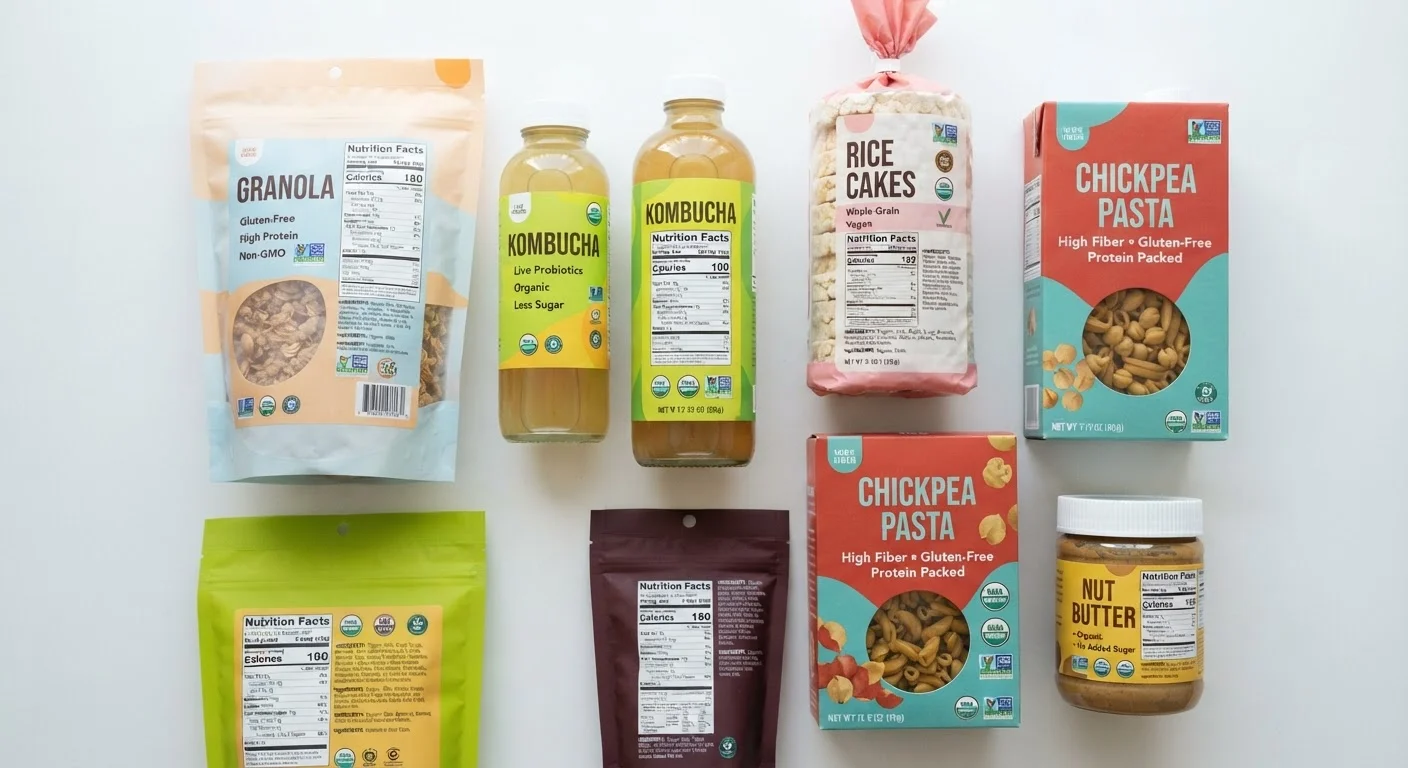
Why Food Label Literacy Matters
Americans buy thousands of packaged foods every year, yet surveys consistently show that most shoppers find nutrition labels confusing or ignore them entirely. That gap between information and understanding costs real health opportunities. Food labels are federally mandated disclosures — not marketing documents — and learning to read them puts you in control of what goes on your plate.
The FDA and USDA regulate what manufacturers must display, how it must be formatted, and what claims are permitted. When you know the rules they follow, you can cut through the noise on the front of the package and go straight to the facts. If you're just getting started, our beginner's walkthrough is a helpful first step.
Decoding the Nutrition Facts Panel
The Nutrition Facts panel — the black-and-white box required on most packaged foods — follows a standardized FDA format updated in 2020. Here's how to read it from top to bottom:
- Serving size: All numbers on the panel apply to this amount, not the whole package. If a bag of chips lists a serving as 1 oz but you eat 3 oz, multiply everything by three.
- Calories: Displayed in large type. This reflects energy per serving.
- Nutrients to limit: Saturated fat, sodium, and added sugars appear prominently because overconsumption is linked to chronic disease risk, according to the USDA Dietary Guidelines for Americans.
- Nutrients to encourage: Dietary fiber, vitamin D, calcium, iron, and potassium are listed because many Americans fall short of recommended intakes.
- % Daily Value (%DV): This tells you how much one serving contributes toward a daily goal based on a 2,000-calorie reference diet. A general rule: 5% DV or less is considered low; 20% DV or more is considered high.
20% DV
Threshold for a "high" nutrient per serving
Per FDA guidelines, 20% Daily Value or more per serving is considered high for any nutrient on the Nutrition Facts panel.
5% DV
Threshold for a "low" nutrient per serving
The FDA defines 5% Daily Value or less per serving as low, a useful benchmark when limiting sodium, saturated fat, or added sugars.
9
Major allergens requiring mandatory disclosure
Federal law (FALCPA and the FASTER Act of 2021) requires clear labeling of nine major allergens on all FDA-regulated packaged foods.
The updated label also separates added sugars from total sugars — a meaningful distinction, because naturally occurring sugars in fruit or dairy behave differently in the body than sugars added during manufacturing.
For a deeper comparison of two similar products using these numbers, see our guide on comparing packaged foods side by side.
Understanding the Ingredient List
Ingredients are listed in descending order by weight — the first ingredient is present in the largest amount, the last in the smallest. This single rule is one of the most powerful tools a shopper has.
A few practical applications:
- If sugar (or any of its many aliases — high-fructose corn syrup, cane juice, dextrose, maltose) appears within the first three ingredients of something marketed as healthy, the product is primarily sweetened.
- In a whole-grain bread, the first ingredient should be a whole grain flour, not enriched wheat flour, which is refined.
- Long ingredient lists aren't automatically bad (a veggie soup may have 20 wholesome ingredients), and short lists aren't automatically good. Context matters.
When scanning ingredient lists for added sugar, look for any word ending in '-ose' (glucose, fructose, dextrose) and common aliases like cane syrup, fruit juice concentrate, or malt syrup — they all count as added sugar.
Manufacturers sometimes use multiple lower-ranking sweeteners so that no single sugar appears near the top of the list, even though their combined contribution is significant.
For packaged items sold in multiserving containers (like a pint of ice cream), mentally multiply the sodium and saturated fat numbers by the number of servings you actually eat — not the serving size printed on the label.
Portion distortion is one of the most common ways shoppers underestimate their intake; the serving size printed reflects a standard reference, not a behavioral norm.
Certain terms in ingredient lists confuse even careful readers. Words like hydrolyzed, fortified, and enriched each mean something specific. Our glossary of confusing label terms breaks them all down plainly.
Health Claims, Structure/Function Claims, and Front-of-Pack Marketing
This is where confusion — and sometimes manipulation — enters the picture. Packaged food labels carry several legally distinct types of statements, and they are not held to the same standard.
Authorized Health Claims
These are FDA-approved statements linking a nutrient or food to a reduced risk of a disease or health condition. An example: "Diets low in saturated fat and cholesterol may reduce the risk of heart disease." Manufacturers must meet rigorous scientific criteria to use these claims.
Structure/Function Claims
These describe how a nutrient affects normal body structure or function — for example, "calcium builds strong bones" or "fiber supports digestive health." They do not require FDA pre-approval and carry a required disclaimer that the FDA has not evaluated the claim.
Front-of-Pack Marketing Language
Terms like natural, clean, wholesome, or simple are largely unregulated marketing language. The FDA has a working definition for natural (nothing artificial or synthetic was added), but it is not a nutrition claim and does not indicate a food is healthful. Train yourself to flip to the back panel whenever the front feels too promotional.
For a full breakdown of how these numbers and terms fit together, this complementary explainer covers the underlying logic clearly.
Allergen Notices and Safe Eating
Under the Food Allergen Labeling and Consumer Protection Act (FALCPA) and subsequent legislation, manufacturers must clearly disclose the presence of nine major allergens: milk, eggs, fish, shellfish, tree nuts, peanuts, wheat, soybeans, and sesame. These nine account for the vast majority of serious allergic reactions in the United States.
Allergens must appear either in the ingredient list itself (e.g., "whey (milk)") or in a separate "Contains" statement directly after the list. "May contain" or "processed in a facility with" statements are voluntary and reflect a manufacturer's cross-contact risk assessment, not a regulatory requirement — but they carry real significance for people with severe allergies.
Allergen Statements Can Change Without Warning
Food manufacturers periodically update formulations, change suppliers, or shift production facilities — any of which can affect allergen content or cross-contact risk. Even if you've safely purchased a product before, check the allergen statement on every purchase. If you or someone you care for has a diagnosed food allergy, consult an allergist for personalized guidance on label reading and cross-contact risk.
If you or someone in your household manages a food allergy, reading the allergen statement every time — even for familiar products — is essential, since formulations can change without prominent notice on the front of the package.
Putting It All Together at the Store
A practical label-reading routine doesn't have to slow your shopping trip. Use this quick sequence at the shelf:
- Check the serving size first. It anchors every number that follows.
- Scan calories and the three nutrients to limit (saturated fat, sodium, added sugars). Are any of them high (%DV ≥ 20%) for a food you'll eat frequently?
- Look at the first three ingredients. They define the product more than anything else on the label.
- Note the allergen statement if relevant to anyone eating the food.
- Treat front-of-pack claims with skepticism until the back panel confirms them.
Label literacy is a skill that compounds over time. The more you practice, the faster and more confident you become — and the less power vague marketing language holds over your choices. For foundational context on balanced eating, explore the Healthy Eating Basics hub or our broader Nutrition Basics resource.
This article is for general informational and educational purposes only and is not a substitute for advice from a registered dietitian or other qualified healthcare professional. Individuals with specific medical conditions, allergies, or dietary needs should consult a qualified professional before making significant dietary changes.
The content on this site is for informational purposes only and is not a substitute for professional advice. Always consult a qualified professional for guidance specific to your situation.