

The Nine Major Allergens Federal Law Covers
Under the Food Allergen Labeling and Consumer Protection Act (FALCPA), food manufacturers must declare the presence of nine major allergens on virtually all packaged foods sold in the United States. These are: milk, eggs, fish, shellfish, tree nuts, peanuts, wheat, soybeans, and sesame. Sesame was added by the FASTER Act of 2021 and became mandatory on labels starting January 1, 2023.
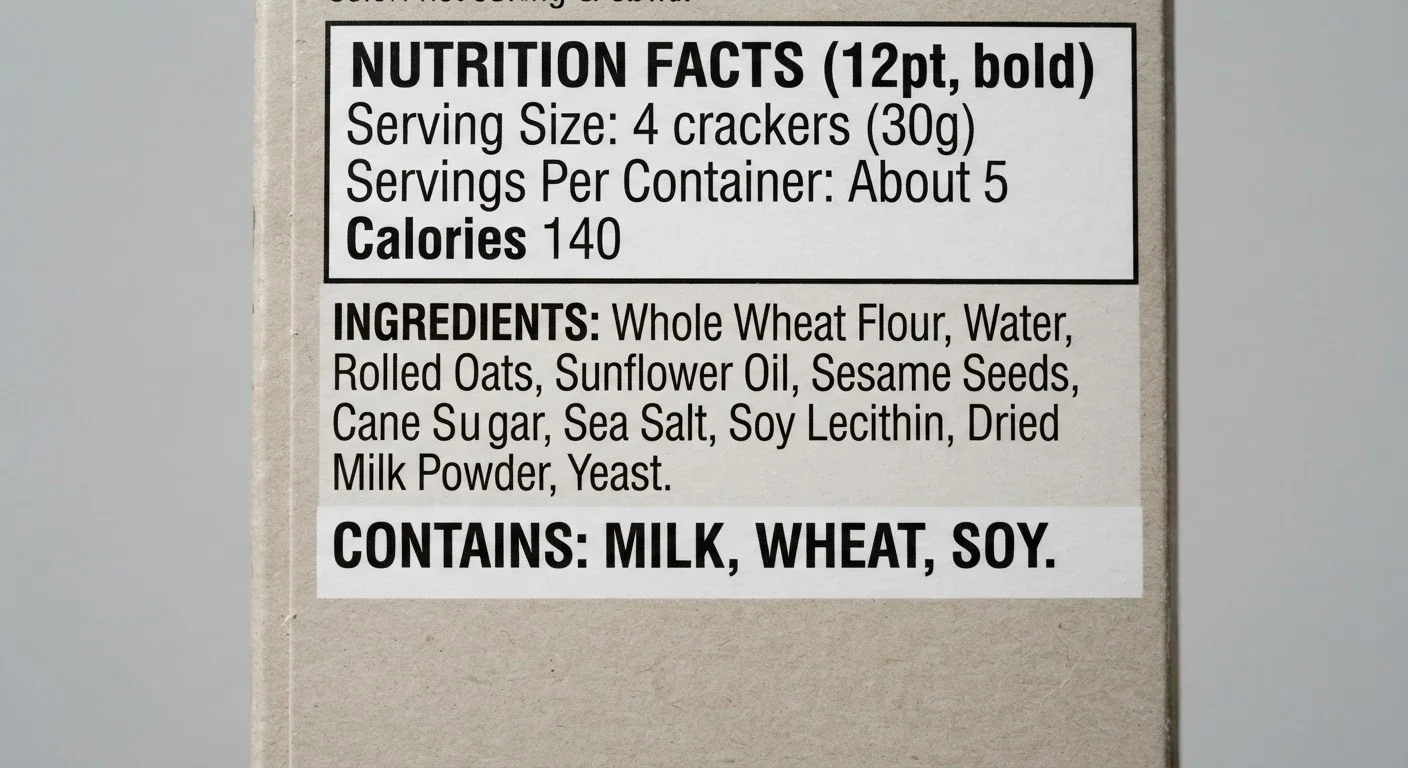
These nine were selected because they collectively account for the overwhelming majority of serious food allergy reactions in the U.S. The FDA requires the declaration to appear in one of two ways: within the ingredient list using plain English (e.g., "milk chocolate (contains milk)"), or in a separate bolded "Contains" statement directly after the ingredient list. Either method satisfies the law.
For tree nuts and fish, specificity matters — manufacturers must identify the exact species. "Tree nuts" alone is insufficient; the label must name the specific nut, such as almonds or cashews. Similarly, "fish" must be identified by type, such as salmon or cod. This specificity matters because individual sensitivities can differ across species within the same food group.
For a broader look at how all elements of a food package work together, see Understanding Food Labels From Start to Finish.
9
Major allergens requiring federal label disclosure
As of January 1, 2023, sesame joined milk, eggs, fish, shellfish, tree nuts, peanuts, wheat, and soybeans under mandatory FDA labeling requirements.
~32 million
Americans living with food allergies
According to research published by Food Allergy Research & Education (FARE), roughly 32 million Americans have a food allergy, including approximately 5.6 million children.
0
FDA standards governing 'may contain' wording
The FDA has not established any regulatory definition or required threshold for precautionary allergen labels, leaving the language entirely at manufacturers' discretion.
What 'May Contain' Labels Mean — and Don't Mean
Here is where many consumers run into confusion: precautionary allergen labels (PALs) — phrases like "may contain peanuts," "processed in a facility with tree nuts," or "made on shared equipment" — are entirely voluntary. The FDA does not require them, does not define them, and does not regulate their wording.
That means two products with similar manufacturing risks might handle labeling very differently. One company might add a "may contain" warning as a broad safety measure; another might omit it despite similar practices. The absence of a precautionary label does not guarantee an allergen-free environment.
When 'May Contain' Appears, Ask More Questions
A precautionary label is a signal worth taking seriously, but its absence isn't a green light. If you manage a severe allergy, reach out to the manufacturer before consuming a new product. Ask specifically whether the allergen is used in the same facility, on shared equipment, or on the same production line — each represents a different level of risk.
This lack of standardization creates real challenges. A 2019 study published in the Journal of Allergy and Clinical Immunology found that a meaningful percentage of products carrying "may contain" labels did contain detectable allergen protein, while some without warnings also tested positive. For people with severe allergies, voluntary labels are a starting point for inquiry, not a guarantee of safety.
If you manage a serious allergy, consider contacting the manufacturer directly to ask about their cross-contact controls — a step that goes beyond what any label can communicate.
Important Gaps and Exemptions in Coverage
FALCPA does not cover every food situation a consumer encounters. Understanding the gaps helps set realistic expectations about what labels can — and cannot — tell you.
- Raw agricultural products: Fresh fruits, vegetables, and unprocessed meats sold without packaging are not subject to FALCPA labeling rules.
- Highly refined oils: Oils derived from allergenic sources but processed to remove proteins — such as highly refined peanut oil — are exempt. Cold-pressed or expeller-pressed versions are not exempt and must be declared.
- Restaurant and food service: Restaurants, cafeterias, and food trucks are generally outside FALCPA's scope. Some states have passed their own allergen disclosure requirements, but these vary significantly. When dining out, asking staff is the most reliable approach.
- Alcohol: Alcoholic beverages regulated by the Alcohol and Tobacco Tax and Trade Bureau (TTB) are not covered by FDA's allergen labeling rules, though the TTB has its own advisory guidance.
- Flavor ingredients: If a major allergen is used in a spice blend or flavor compound, it must still be declared — but incidental additives that carry no allergenic function may have different treatment.
Allergen labeling is one piece of a larger label literacy picture. Compare it with other regulated claims in Natural, Organic, and Non-GMO: What These Label Claims Are Actually Regulated to Mean.
How to Read Labels More Effectively
Armed with the above, here is a practical framework for using allergen information on packaging.
- Check the ingredient list first. Allergens must appear in plain English, so scan for the specific allergen name — not just the product category. "Casein" alone would not satisfy the law; "casein (milk)" or a separate "Contains: Milk" statement is required.
- Look for the 'Contains' statement. If present, it appears directly after the ingredient list and summarizes declared allergens at a glance. Note that its absence doesn't mean the product is allergen-free — some manufacturers include allergen language in the ingredient list only.
- Evaluate precautionary labels with appropriate skepticism. A "may contain" warning signals that the manufacturer acknowledges a cross-contact risk, which is useful information. But the absence of such a label is not a safety guarantee.
- Contact manufacturers when stakes are high. For severe or life-threatening allergies, a phone call or email to the manufacturer asking about shared equipment and production lines provides detail no label can convey.
For a complete guide to decoding every section of a nutrition panel, see What Nutrition Labels Are Actually Telling You.
This article is for general informational purposes only and is not medical advice. If you or someone in your care has a food allergy, consult a qualified allergist or healthcare professional for personalized guidance and an emergency action plan.
Frequently Asked Questions
The FDA requires labeling for milk, eggs, fish, shellfish, tree nuts, peanuts, wheat, soybeans, and sesame. Sesame was added as the ninth major allergen under the FASTER Act, with mandatory labeling effective January 1, 2023. These nine account for the vast majority of serious food allergy reactions in the U.S.
No. Precautionary allergen labels like 'may contain' or 'made in a facility that also processes' are entirely voluntary under current federal law. Manufacturers use them at their own discretion, and there is no FDA standard governing when or how they must be worded.
FALCPA applies primarily to packaged foods regulated by the FDA. Restaurants and food service establishments are generally not required to provide allergen disclosures under the same federal rules, though some states have enacted their own requirements. Always ask staff directly about ingredients when dining out.
Manufacturers have two compliant options: list the allergen in plain English within the ingredient list (for example, 'flour (wheat)'), or include a separate 'Contains: Wheat' statement immediately following the ingredient list. Both formats satisfy federal requirements.
No. Highly refined oils derived from major allergens — such as highly refined peanut oil — are exempt from FALCPA labeling requirements because the refining process removes most allergenic proteins. However, cold-pressed or expeller-pressed oils are not exempt and must be declared.
Reading labels is important, but people with severe allergies should also contact manufacturers directly about shared equipment or production practices, consult an allergist for personalized guidance, and carry any prescribed emergency medication. This article is general information, not medical advice — always work with a qualified healthcare professional.
The content on this site is for informational purposes only and is not a substitute for professional advice. Always consult a qualified professional for guidance specific to your situation.