

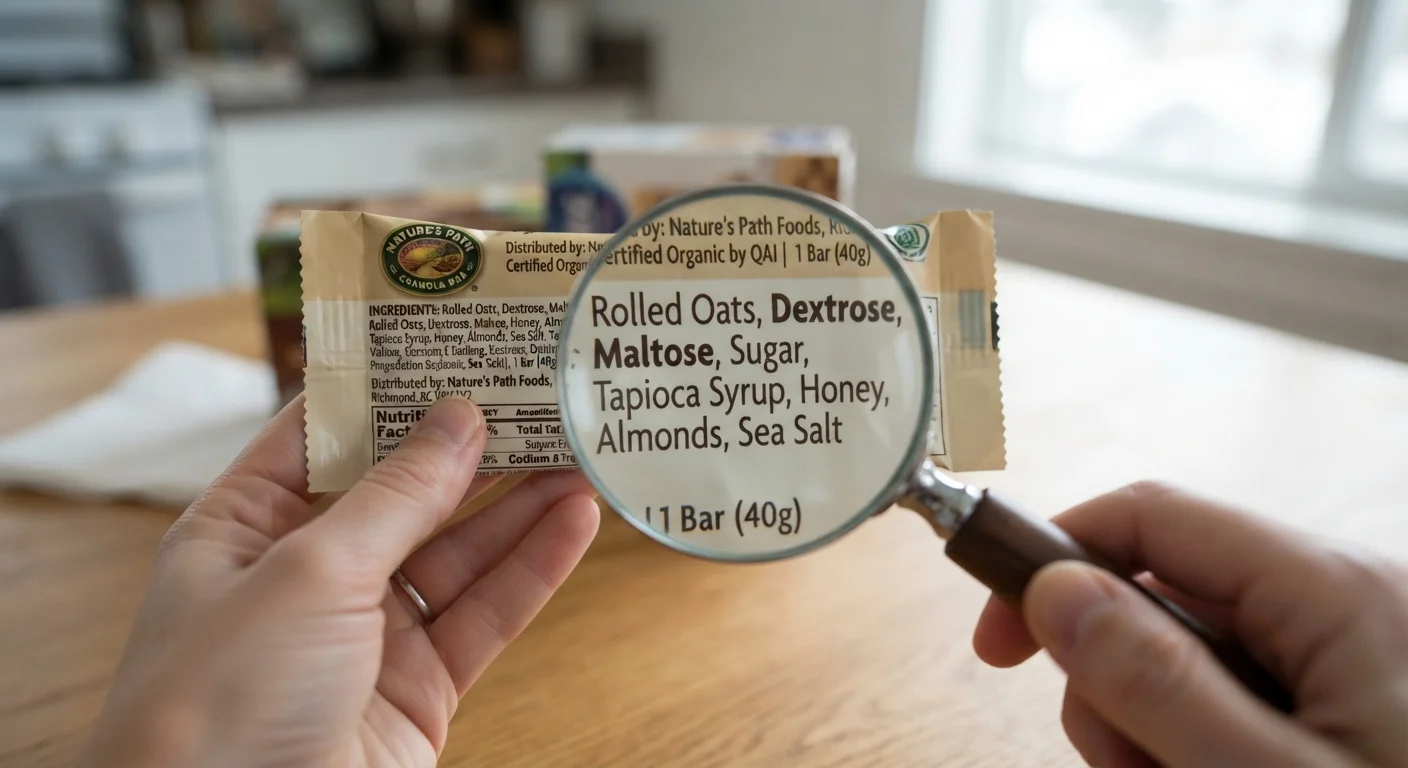
Why Added Sugars Are So Hard to Spot
Reading an ingredient list should be straightforward — but food manufacturers legally use dozens of names for added sugar, making it genuinely difficult to gauge how much sweetener a product contains. A granola bar labeled "no high-fructose corn syrup" might still deliver several teaspoons of added sugar through cane juice, brown rice syrup, and dextrose listed separately.
Because ingredient lists are ordered by weight, a manufacturer can use three or four different sugar sources and keep each one lower on the list — even though their combined contribution is substantial. Understanding this tactic is the first step toward reading labels more accurately.
The Nutrition Facts panel now includes a dedicated "Added Sugars" line (measured in grams), which is the clearest single number to check. But cross-referencing that number with the ingredient list helps you understand what kind of added sugar you're getting and how prominently it features in the product. For a deeper look at how those two figures relate, see Added Sugars vs. Total Sugars on Nutrition Labels.
| Number of added sugar aliases | More than 60 recognized names (U.S. Food & Drug Administration labeling guidance) |
| FDA Daily Value for added sugars | 50 grams (based on 2,000-calorie diet) (FDA Nutrition Facts label regulations) |
| Ingredient list ordering rule | By weight, heaviest to lightest (21 CFR Part 101, FDA ingredient labeling rules) |
| Added Sugars line on labels | Required since 2020 for most manufacturers (FDA updated Nutrition Facts label mandate) |
| Common disguised sugar in "healthy" products | Fruit juice concentrate, agave nectar, brown rice syrup |
The Master List: Added Sugar Aliases
The following names all refer to ingredients that function as added sugars. They vary in sweetness level, glycemic impact, and processing method, but nutrition science broadly groups them together for labeling purposes. Familiarizing yourself with these categories makes scanning ingredient lists much faster.
Added Sugar
Any sugar or caloric sweetener that is added to a food or beverage during processing or preparation, rather than occurring naturally in the whole ingredient. The FDA requires this amount to be listed separately on Nutrition Facts labels.
High-Fructose Corn Syrup (HFCS)
A liquid sweetener made by processing corn starch to convert some of its glucose into fructose. It is widely used in processed foods and beverages and is chemically similar to table sugar (sucrose).
Dextrose
A simple sugar chemically identical to glucose, derived from corn or wheat starch. It appears frequently in baked goods, sports drinks, and processed snacks and raises blood sugar quickly.
Evaporated Cane Juice
A minimally processed sweetener made by evaporating liquid from sugarcane. Despite its natural-sounding name, it is classified as an added sugar and is nutritionally comparable to conventional cane sugar.
Fruit Juice Concentrate
Fruit juice that has had most of its water removed, resulting in a very sweet, dense liquid. When used as an ingredient to sweeten a product, the FDA classifies it as an added sugar.
Maltodextrin
A mildly sweet or nearly flavorless carbohydrate derived from starch, often used as a thickener or filler. It has a high glycemic index and is counted as an added sugar when used to sweeten products.
Syrups and Liquid Sweeteners
- High-fructose corn syrup (HFCS)
- Brown rice syrup
- Corn syrup / corn syrup solids
- Malt syrup
- Maple syrup
- Agave nectar / agave syrup
- Golden syrup
- Sorghum syrup
"-ose" Sugars (Chemically Named)
- Sucrose (table sugar)
- Fructose / crystalline fructose
- Glucose
- Dextrose
- Maltose
- Lactose (added, not naturally occurring in dairy)
- Galactose
"Natural" or Minimally Processed Sugars
- Cane sugar / raw cane sugar / cane juice / evaporated cane juice
- Coconut sugar / coconut palm sugar
- Date sugar / date syrup
- Honey
- Molasses / blackstrap molasses
- Turbinado sugar
- Muscovado sugar
- Demerara sugar
Concentrated Fruit-Based Sweeteners
- Fruit juice concentrate (apple, grape, pear)
- Dried fruit (when used primarily as a sweetener)
Other Industrial Sweeteners
- Dextrin / maltodextrin
- Caramel
- Carob syrup
- Barley malt
Not all of these are treated identically by the body — how added and natural sugars differ is a nuanced topic worth exploring separately. What they share is that they were introduced during processing rather than occurring naturally in the whole ingredient.
"Natural" Doesn't Mean Unrestricted
Honey, maple syrup, coconut sugar, and date syrup are often marketed as healthier alternatives to table sugar. While they may retain trace minerals or have a slightly different glycemic response, the FDA classifies all of them as added sugars when used as sweetening ingredients. From a labeling standpoint, they count toward your daily Added Sugars total just like any other sweetener. Moderation still applies.
Practical Label-Reading Strategies
Knowing the aliases is useful, but applying that knowledge at the grocery store requires a quick system. Here are practical steps to make label reading efficient:
- Check the Added Sugars line first. The grams figure gives you the clearest total. The FDA's Daily Value reference is 50 grams per day for a 2,000-calorie diet — one serving at 12g already represents nearly a quarter of that.
- Scan the first five ingredients. Because ingredients are listed by descending weight, a sugar name in the top five means the product contains a meaningful amount.
- Count the sugar aliases. If you spot two or more names from the lists above, the combined sugar contribution is likely higher than any single entry suggests.
- Watch the serving size. A product might list 4g of added sugar per serving, but if the serving size is two cookies and you eat six, the math changes significantly. This same issue applies to sodium — see how sodium numbers add up across a day for a parallel example.
- Be skeptical of "no added sugar" marketing. A product can use fruit juice concentrate — which the FDA classifies as an added sugar — and still make certain marketing claims. Check the ingredient list regardless of front-of-package wording. Similarly, reduced-fat products often compensate with added sugar, so both labels deserve a look together.
This article is for general informational purposes only and is not medical or dietary advice. Speak with a registered dietitian or qualified healthcare professional for guidance tailored to your individual health needs.
The content on this site is for informational purposes only and is not a substitute for professional advice. Always consult a qualified professional for guidance specific to your situation.