

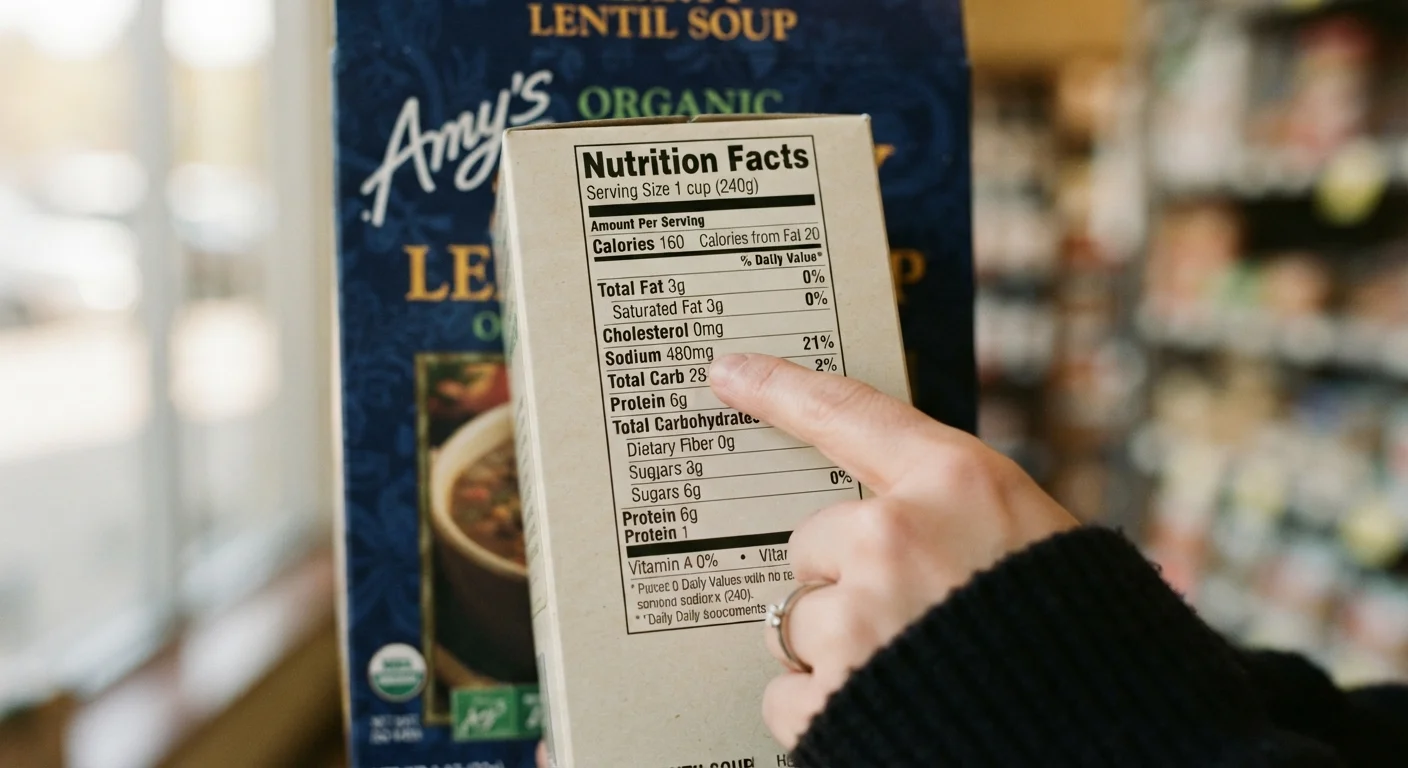
Why Sodium Sneaks Up on Most Americans
According to the U.S. Dietary Guidelines for Americans, most adults consume well over 3,400 mg of sodium per day — nearly 50% more than the recommended limit of 2,300 mg. What makes this surprising isn't heavy salt use at the dinner table. It's the sodium already built into packaged and processed foods before they reach your plate.
The math becomes clearer when you look at a single day: a bowl of canned soup (around 800–900 mg per serving), two slices of bread (roughly 200–300 mg), a tablespoon of soy sauce (nearly 900 mg), and a serving of deli turkey (400–600 mg) can collectively push you past 2,300 mg without a single extra shake of the salt shaker. Understanding how sodium is reported on a Nutrition Facts label is the first step toward making sense of those totals. For a broader walkthrough of label sections, see what nutrition labels are actually telling you.
Sodium Is Naturally Present in Some Foods Too
Not all sodium comes from added salt or processing. Foods like milk, beets, celery, and shellfish contain naturally occurring sodium. While these amounts are generally much smaller than processed food sources, they still count toward your daily total. Keep this in mind when you're assessing your overall intake.
How to Read Sodium on a Food Label Accurately
Follow these steps each time you pick up a packaged food. The process takes under a minute once you know what to look for.
Find the serving size first — before anything else
Every number on the Nutrition Facts panel is tied to one serving, not the whole package. Locate the Serving Size at the very top of the panel. If a bag of crackers lists a serving as 15 crackers and you typically eat 30, every sodium figure doubles for your actual intake.
Read the sodium line in milligrams
Locate Sodium in the nutrient section — it's listed in milligrams (mg). Note this number directly. Do not rely solely on the %DV percentage; the mg figure lets you add up your intake across multiple foods during the day.
Multiply by servings consumed
If the label shows 480 mg per serving and you ate two servings, your actual sodium intake from that food is 960 mg — nearly half the daily recommended limit in one item. Always do this multiplication before moving on.
Check the number of servings per container
The label field Servings Per Container tells you how many servings the whole package holds. A small bag of soup mix labeled "2 servings" means all the sodium numbers must be doubled to reflect eating the entire bag — something many people do without realizing it.
Add up sodium across your full day — not just one meal
Sodium accumulates across every food and beverage you consume. After checking labels throughout the day, total your mg count. Comparing that to the 2,300 mg guideline for generally healthy adults gives you an honest picture of your actual intake pattern — and where the biggest contributors are hiding.
Once you've worked through a few labels this way, the pattern becomes second nature. Sodium is listed in milligrams (mg) and as a percentage of the Daily Value (%DV), where 5% DV or less is considered low and 20% DV or more is considered high — a shorthand the FDA formalizes on the label itself. For a full plain-language explanation of how each section of the panel fits together, reading a nutrition label without getting confused breaks it down clearly.
"Per Serving" Can Be Misleading at a Glance
Manufacturers are permitted to set serving sizes based on what they consider a typical eating occasion, which doesn't always match real-world portions. A single-serve beverage bottle, for example, may list two servings. Always verify servings per container and multiply accordingly — the math is quick but the difference in sodium can be significant.
Sodium Claims on Packaging: What They Actually Mean
Food marketers use sodium-related terms on front-of-package labels, and each has a precise legal definition set by the FDA. Knowing these keeps you from being misled:
- Sodium-free: Less than 5 mg per serving.
- Very low sodium: 35 mg or less per serving.
- Low sodium: 140 mg or less per serving.
- Reduced sodium: At least 25% less sodium than the regular version — not necessarily low overall.
- Light in sodium: At least 50% less sodium than the regular product.
- No salt added / Unsalted: No salt added during processing, but the food may still contain naturally occurring sodium.
"Reduced sodium" is among the most misunderstood. A product can be reduced sodium and still deliver 500+ mg per serving if the original contained 700+ mg. Always check the milligrams, not just the claim. This same skepticism applies to sugar labeling — added sugars hide under many names the same way sodium does across ingredient lists.
Unexpected High-Sodium Foods Worth Watching
Salty snacks get most of the attention, but several everyday foods contribute significant sodium in ways that catch people off guard:
- Bread and rolls
- Two slices of standard white bread can contain 280–400 mg — not because bread tastes salty, but because salt is used in fermentation and flavor balance.
- Cottage cheese
- A half-cup serving often contains 350–450 mg, making it one of the higher-sodium dairy options.
- Canned vegetables
- Even "healthy" staples like canned tomatoes or green beans can carry 300–400 mg per half-cup. Rinsing canned beans and vegetables under water can reduce sodium by roughly 40%, according to research published in food science literature.
- Breakfast cereals
- Many contain 150–300 mg per cup, with some brands reaching higher — particularly flavored varieties.
Ingredient lists can also reveal sodium-containing additives like sodium benzoate, monosodium glutamate (MSG), and sodium bicarbonate (baking soda). Understanding that ingredients are listed by weight — not prominence — helps you gauge how significant each additive is. Ingredient lists follow rules most shoppers don't know about, and learning them gives you a clearer picture of what's actually in the package.
This article is for general informational and educational purposes only and is not a substitute for advice from a qualified healthcare professional or registered dietitian. Individual dietary needs vary. Consult a healthcare provider before making significant changes to your diet, especially if you have a medical condition such as hypertension or kidney disease.
The content on this site is for informational purposes only and is not a substitute for professional advice. Always consult a qualified professional for guidance specific to your situation.