

The Three Pit-Stop Types You'll Actually Encounter
If you've ever cruised past a brown highway sign and wondered whether it was worth pulling in, you're not alone. The American road trip network includes three distinct types of roadside stops — and knowing the difference helps you plan smarter breaks, dodge fatigue, and squeeze more out of every mile.
| Who operates rest areas | State departments of transportation |
| Typical cost to use | Free |
| Staffed during daytime hours | State welcome centers only |
| Recommended break frequency | Every 2 hours or ~100 miles (General traffic safety guidance) |
| Typical interstate rest area spacing | 40–80 miles apart |
| Traveler info hotline | Dial 511 (most US states) |
Interstate Rest Areas
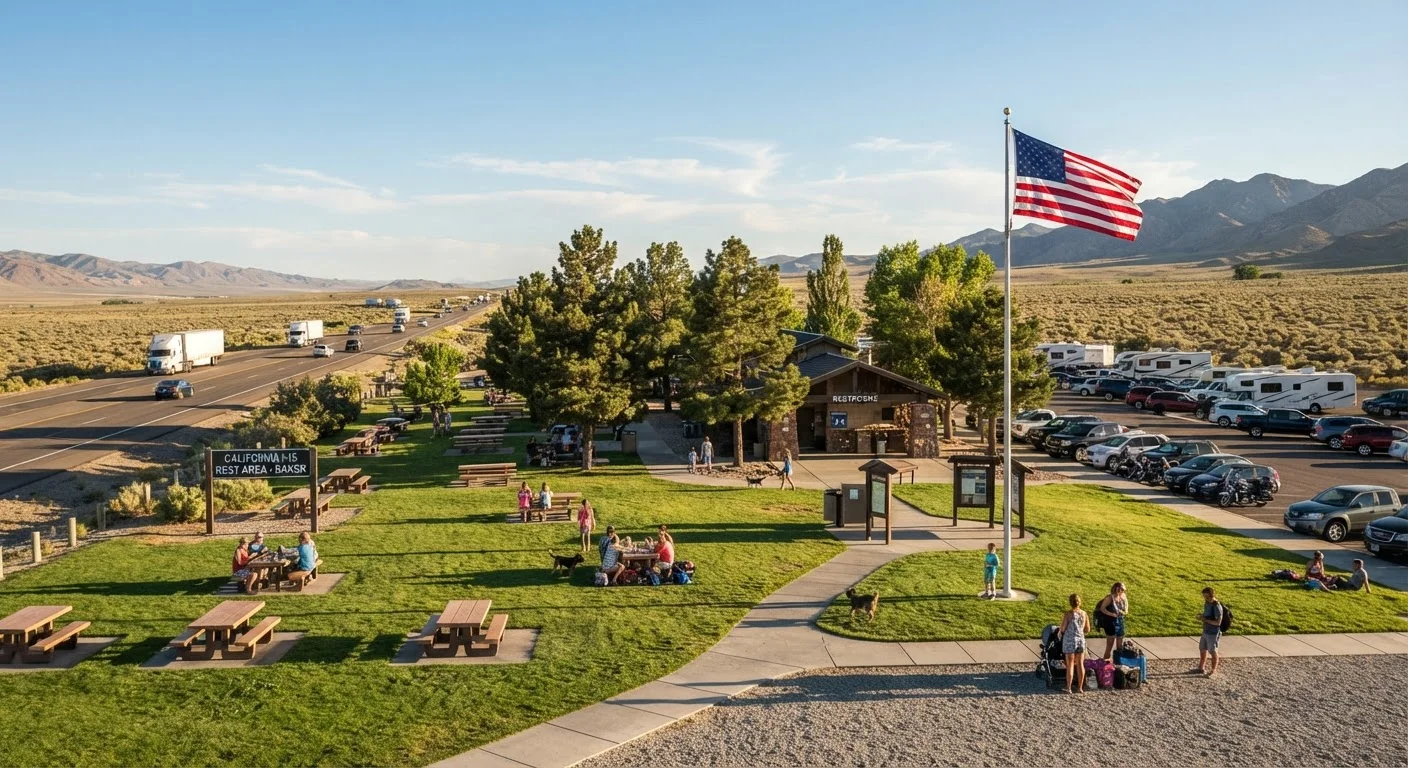
Operated by state departments of transportation, interstate rest areas are the most common stop along US highways. They typically offer restrooms, vending machines, pet-walking areas, and covered picnic shelters. Many newer facilities include EV charging stations and RV dump stations, though availability varies widely by state. Rest areas are free to use and open 24 hours in most states, though a handful close overnight or seasonally — always worth confirming before a late-night leg.
State Welcome Centers
State welcome centers (sometimes called visitor centers) sit right at or near state border crossings on major interstates. Beyond the amenities of a standard rest area, they staff travel counselors during daytime hours who can hand out free maps, recommend local attractions, and flag road construction alerts. They're genuinely useful at the start of a new state — especially if you're new to multi-day driving and want a human being to point you in the right direction.
Scenic Pull-Offs
Scenic pull-offs (also called overlooks or turnouts) are short paved or gravel areas along highways and byways designed for brief stops to photograph a view, stretch your legs, or read an interpretive sign. They're common on mountain passes, coastal highways, and federally designated scenic corridors. They're not equipped with restrooms or services, but they deliver something the other two can't: the actual scenery you drove there to see. Check out what a scenic byway designation actually means to understand which routes tend to have the most pull-offs.
How to Use Each Stop Effectively
Knowing the stops exist is only half the equation — using them strategically keeps you safe and on schedule.
Interstate Rest Area
A state-operated facility along an interstate highway providing restrooms, picnic areas, and basic amenities at no cost. Most are open 24 hours, though policies vary by state.
State Welcome Center
A staffed visitor facility located near a state border crossing that offers travel information, free maps, and local recommendations in addition to standard rest area amenities.
Scenic Pull-Off
A short paved or gravel area beside a highway designed for brief stops to enjoy a viewpoint or read interpretive signage. No restrooms or services are provided.
RV Dump Station
A facility at some rest areas allowing recreational vehicle travelers to empty wastewater tanks. Availability varies widely — confirm before relying on one along your route.
511 Service
A nationwide traveler information hotline in the US that provides real-time road conditions, construction updates, and closures. Dial 511 from most US phone networks.
Mile Marker
Numbered signs placed at regular intervals along US highways used to identify precise locations. Advance signage for rest areas typically references the upcoming mile marker where the facility is located.
Spacing Your Rest Stops
Traffic safety research consistently recommends taking a break every two hours or roughly 100 miles, whichever comes first. Rest areas on major interstates are typically spaced 40–80 miles apart, so gaps rarely become a problem on well-traveled routes. On rural two-lane roads or classic routes like Route 66, services thin out considerably — plan fuel and restroom stops in advance.
Safety Considerations
Most interstate rest areas are well-lit, monitored by cameras, and patrolled by state troopers. That said, common-sense precautions apply: park in well-lit areas, keep valuables out of sight, and lock your vehicle. Solo travelers in particular should review practical solo road trip safety habits for a fuller picture. Overnight parking rules vary by state — some welcome it for tired drivers, others prohibit stays beyond a few hours.
Making the Most of Welcome Centers
Travel counselors at welcome centers are often locals with firsthand knowledge of road conditions, hidden viewpoints, and free attractions nearby. Free printed maps are still available at most centers and can serve as a reliable backup when cell signal disappears in rural stretches. Welcome centers sometimes stock coupon booklets for local lodging and dining — useful if you're watching your budget and looking for practical ways to spend less on the road.
Scenic Pull-Off Etiquette
Pull-offs are designed for brief stops, not extended picnics. Keep your visit under 15–20 minutes when others are waiting, don't block the travel lane while slowing down, and stay behind any guardrails or fencing — these exist because the terrain beyond can be genuinely dangerous. Drone flying is restricted at many pull-offs within national park corridors, so check local rules before launching.
Quick Tips for Finding Stops Before You Go
A little advance research eliminates most unpleasant surprises on the road.
Rest Area Closures Do Happen
Individual rest areas can be temporarily closed for maintenance, budget constraints, or seasonal conditions — especially in northern states during winter. Before a long drive, it's worth checking the relevant state DOT website or calling 511 to confirm facilities are open along your planned route. Don't assume a stop shown on an older map is still operating at full capacity.
- State DOT websites list rest area locations and amenity details — search " rest areas" to find the official page.
- Navigation apps (general-purpose map apps) can filter for rest stops and welcome centers along a planned route, though listings aren't always current on facility status.
- Mile marker signage on interstates typically warns of upcoming rest areas one to two miles in advance — watch for the blue-and-white signs.
- 511 services — the nationwide traveler information phone line — can report closures and road conditions in many states before you hit the road.
- For long overnight drives, identify rest areas with 24-hour confirmed access ahead of time rather than assuming all facilities will be open.
Rest stops, welcome centers, and pull-offs don't cost a thing to use — and they make every road trip safer, more comfortable, and more memorable. Whether you're scanning the horizon from a mountain overlook or chatting with a travel counselor just inside a new state line, these stops are a genuine feature of the American driving experience, not just an inconvenience to speed past.
The content on this site is for informational purposes only and is not a substitute for professional advice. Always consult a qualified professional for guidance specific to your situation.