

The One Column Most People Skip
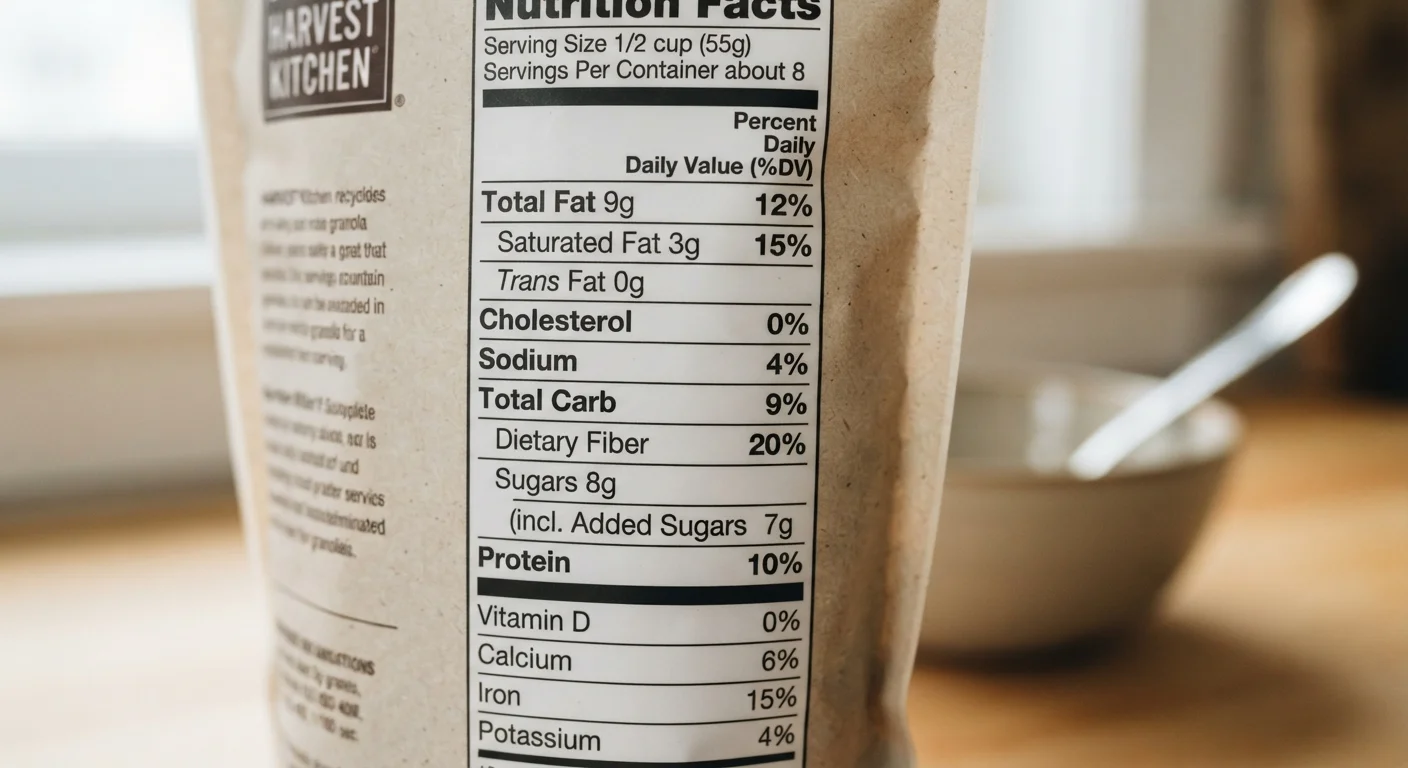
Flip over almost any packaged food and you'll find the Nutrition Facts panel. Most people scan the calories, maybe glance at sodium, and move on. The column on the right — the one listing numbers followed by a percent sign — gets far less attention. That's a missed opportunity, because the Percent Daily Value (%DV) column is often the most useful tool on the entire label.
%DV answers a simple question: Out of everything I should eat today, how much of this nutrient does one serving cover? Instead of asking yourself whether 470 mg of sodium is a lot or a little, you can look at the %DV and immediately see that it's 20% of the daily recommended limit — a meaningful chunk of one day's budget from a single serving.
For a full breakdown of how the Nutrition Facts panel is organized from top to bottom, see our complete row-by-row guide.
The 5% and 20% Rule of Thumb
The FDA offers a straightforward benchmark that makes %DV immediately actionable:
- 5% DV or less = low in that nutrient
- 20% DV or more = high in that nutrient
Whether high or low is good depends on the nutrient. The label is essentially split into two camps:
- Nutrients to limit
- Saturated fat, trans fat, sodium, and added sugars. For these, a lower %DV per serving is generally better.
- Nutrients to get enough of
- Dietary fiber, vitamin D, calcium, iron, and potassium. For these, a higher %DV per serving is a positive sign.
This two-category framework removes a lot of the guesswork. You don't need to memorize daily milligram targets — the %DV does that math for you.
2,000
Calorie baseline for all %DV calculations
The FDA uses a 2,000-calorie reference diet as the standard for calculating %DV on all U.S. Nutrition Facts labels.
20%+
DV threshold for a 'high' nutrient claim
According to FDA guidance, a %DV of 20% or more per serving is the benchmark considered 'high' in any given nutrient.
5% or less
DV threshold for a 'low' nutrient claim
The FDA defines 5% DV or less per serving as 'low,' a useful cutoff for identifying foods low in sodium, saturated fat, or added sugars.
What %DV Doesn't Tell You
%DV is a useful shortcut, but it has real limitations worth understanding.
It's based on a 2,000-calorie reference diet. This is a standardized baseline set by the FDA — not a target for every person. Someone who needs significantly more or fewer calories will have proportionally different nutrient needs. Use %DV as a ballpark guide, not a precise personal tracker.
It applies to one serving only. This is where many label readers go wrong. If a bag of chips lists a serving as 1 oz (about 15 chips) and you eat three times that, the sodium %DV triples too. Always start by checking the serving size at the top of the panel — it anchors every other number on the label. For a closer look at how sodium can accumulate across a day, see how sodium adds up faster than you'd expect.
Not every nutrient has a %DV. Trans fat, total sugars (as distinct from added sugars), and some proteins currently have no established %DV, so those rows show only a gram amount.
A Note on Special Dietary Needs
Because %DV is based on a standardized reference diet, it may not reflect the specific nutrient needs of people who are pregnant, managing a chronic condition, or following a medically supervised diet. If you have individualized dietary requirements, a registered dietitian can help you interpret label information in context of your personal health goals.
Using %DV to Compare Foods
One of the most practical uses of %DV is side-by-side comparison. Because every label uses the same reference values, %DV creates a level playing field. Comparing two brands of canned tomato soup? Line up the sodium %DV and the fiber %DV and the comparison is instant — no unit conversion required.
This works especially well when evaluating foods marketed with health claims. A package labeled "good source of fiber" must provide at least 10% DV per serving, while "excellent source" requires 20% DV or more — these are regulated terms. Knowing that, you can look past the front-of-package marketing and verify the claim yourself in seconds.
If you're new to reading labels overall, this plain-language walkthrough for first-time label readers is a good starting point before diving deeper into individual columns.
Putting %DV Into Daily Practice
The goal isn't to obsessively hit 100% DV for every nutrient from every meal. It's to build a general awareness of where your food falls on the spectrum over the course of a day. A breakfast with 30% DV of sodium is worth knowing about if lunch and dinner tend to run high too.
A simple habit: when picking up a packaged food, glance at the %DV for sodium, saturated fat, added sugars, and fiber. Those four rows cover a wide range of diet quality signals. If most of your day's foods show low %DVs for the "limit" nutrients and moderate-to-high %DVs for the "get enough" nutrients, you're generally tracking well.
For a broader picture of what the entire Nutrition Facts panel is communicating — including serving sizes, ingredients, and health claims — see what nutrition labels are actually telling you.
This article is for general informational and educational purposes only and is not a substitute for personalized advice from a registered dietitian or qualified healthcare professional.
Frequently Asked Questions
A %DV of 20% or more means one serving provides a high amount of that nutrient for the day. For beneficial nutrients like fiber or calcium, that's a good thing. For nutrients to limit — like sodium or saturated fat — a 20% or higher %DV is a signal to eat that food sparingly.
Not exactly. %DV is calculated using a standardized 2,000-calorie reference diet set by the FDA. Your actual needs may be higher or lower depending on your age, sex, activity level, and health status. Use %DV as a general guide, not a precise personal prescription.
Look for higher %DV in dietary fiber, vitamin D, calcium, iron, and potassium — nutrients many Americans don't get enough of, according to the USDA Dietary Guidelines. Foods with 10–20% or more of these per serving are generally good sources.
%DV is calculated for a single serving as listed on the label. If you eat two servings, you double the %DV for every nutrient. Always check the serving size before interpreting %DV numbers — this is one of the most common label-reading mistakes.
The %DV for added sugars — set at 50 grams per day — was introduced as part of the FDA's updated Nutrition Facts label that was rolled out between 2018 and 2020. Older products still using the previous label format may not include it.
The content on this site is for informational purposes only and is not a substitute for professional advice. Always consult a qualified professional for guidance specific to your situation.