

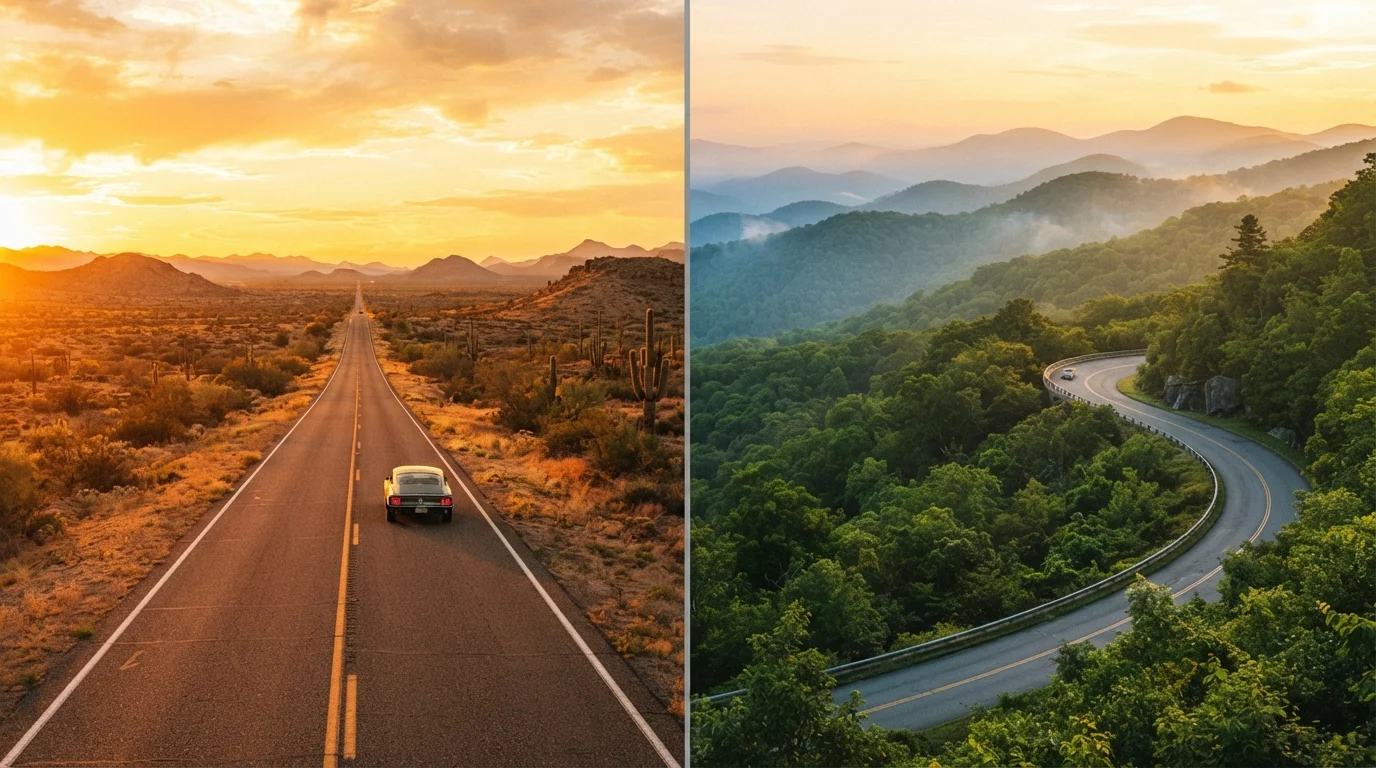
Option A
Route 66
The legendary Mother Road — a cross-country cultural odyssey.
Best for: Road trippers who want big mileage, roadside Americana, and a slice of mid-century American history spanning eight states.
Option B
Blue Ridge Parkway
The Appalachian scenic retreat — slow, stunning, and deeply natural.
Best for: Drivers who prioritize mountain scenery, hiking access, and a peaceful weekend or week-long escape along the East Coast.
The Big Picture: Scale, Geography, and What You're Signing Up For
Route 66 and the Blue Ridge Parkway are both icons — but they are icons of entirely different things. Understanding that difference upfront will save you from a mismatched trip.
Route 66 runs approximately 2,400 miles from Chicago, Illinois, to Santa Monica, California. It's not a single continuous highway in the traditional sense; it's a historic alignment of local and state roads that stitches together eight states — Illinois, Missouri, Kansas, Oklahoma, Texas, New Mexico, Arizona, and California. You'll pass through cities, rural towns, vast desert stretches, and everything in between. Budget at minimum two weeks if you want to experience it meaningfully.
The Blue Ridge Parkway is a unit of the National Park System connecting Shenandoah National Park in Virginia to Great Smoky Mountains National Park in North Carolina — exactly 469 miles of ridge-hugging, view-packed roadway. It's a purpose-built scenic drive with no commercial vehicles allowed and a 45 mph speed limit throughout. A focused driver could complete it in two days, but most travelers spread it across four to seven days to absorb the overlooks and trails.
For a broader look at how these two stack up against other celebrated American routes, see America's Classic Road Trip Routes.
| Criterion | Route 66 | Blue Ridge Parkway |
|---|---|---|
| Total length | ~2,400 miles | 469 miles |
| States crossed | 8 states (IL to CA) | 2 states (VA and NC) |
| Typical drive time | 2–3 weeks minimum | 4–7 days ideally |
| Cost to drive | Fuel + tolls on some roads | Free (no entry fee) |
| Speed limit | Varies by road segment | 45 mph throughout |
| Primary draw | History, culture, Americana | Mountain scenery, foliage, nature |
| Best season | Spring or early fall | Summer or October (peak foliage) |
| Winter access | Generally open year-round | High-elevation sections may close |
| Cell coverage | Spotty in rural sections | Limited; plan for offline maps |
| Hiking access | Limited along the road itself | Numerous trailheads throughout |
Scenery and Atmosphere: Desert Kitsch vs. Mountain Serenity
Route 66's scenery is wildly varied — and that's the point. You'll roll through the flat farmland of Illinois, hit the rolling Ozarks in Missouri, cross the sweeping Texas Panhandle, and eventually arrive in the red-rock splendor of Arizona and New Mexico. The visual experience is punctuated by vintage motels, hand-painted murals, rusted gas stations, and roadside oddities that no algorithm could have invented. It's a road defined as much by human culture as by landscape.
The Blue Ridge Parkway operates on a completely different emotional register. There are no billboards. No fast-food chains visible from the road. Just layered ridgelines, meadows, wildflower fields, and a consistent sense that you've stepped out of modern American life entirely. In October, when hardwood forests ignite with color, the Parkway is genuinely one of the most visually striking drives anywhere in the country. Comparing fall drives across different regions puts the Parkway's foliage season in useful national context.
469
Miles of the Blue Ridge Parkway
The Parkway is one of the most visited units in the National Park System, drawing tens of millions of visits annually according to NPS data.
~2,400
Miles of historic Route 66
Route 66 was officially decommissioned as a US highway in 1985 but continues to be maintained and celebrated as a historic corridor across eight states.
45 mph
Blue Ridge Parkway speed limit
The strictly enforced limit is intentional — the Parkway was designed for leisurely scenic driving, not as a transit route.
Logistics: Planning, Cost, and On-the-Road Realities
Route 66 demands more planning. Because it runs through commercial areas, accommodations range from legendary historic motels to basic chain hotels — availability and quality vary dramatically by town. Fuel costs add up over 2,400 miles, and cell coverage can be genuinely spotty in rural Oklahoma, the Texas Panhandle, and stretches of New Mexico. Before heading out, it's worth reviewing common road trip myths that catch first-timers off guard.
The Blue Ridge Parkway is free to drive, and the National Park Service maintains it well. Gas stations exist near the Parkway but not on it, so topping off in towns before accessing the road is standard practice. Cell service is limited in many sections — download offline maps before you go. Some sections at higher elevations close from late November through March due to ice. Timing matters significantly on both routes, and seasonal driving timing across US regions is worth reading before you lock in dates.
If the Great River Road is also on your radar as a third alternative, driving the Great River Road offers a helpful comparison point for long-form American byway travel.
Which Road Is Right for You?
Here's the honest take: these routes don't really compete with each other — they serve different travel souls. If you're someone who gets a thrill from stumbling into a 1950s diner in Amarillo or photographing a hand-painted mural in Tucumcari, Route 66 will exceed every expectation. If you'd rather park at a mountain overlook and listen to wind move through a stand of hardwood trees, the Blue Ridge Parkway will feel like a gift.
Both roads reward slow travel. Both will leave you with stories. And neither requires a special vehicle, permit, or extreme budget to enjoy — just a reliable car, a flexible itinerary, and genuine curiosity about what's around the next bend.
Travel conditions, road closures, and seasonal access change regularly. Always verify current conditions with the National Park Service (for the Blue Ridge Parkway) and relevant state transportation departments (for Route 66 segments) before departing.
The content on this site is for informational purposes only and is not a substitute for professional advice. Always consult a qualified professional for guidance specific to your situation.