

Option A
Serving Size
The reference amount — not a recommendation.
Best for: Understanding the unit all other numbers on the label are calculated against.
Option B
Servings Per Container
The multiplier most people forget to use.
Best for: Knowing how many times to multiply the label numbers to get your actual intake.
What Each Term Actually Means
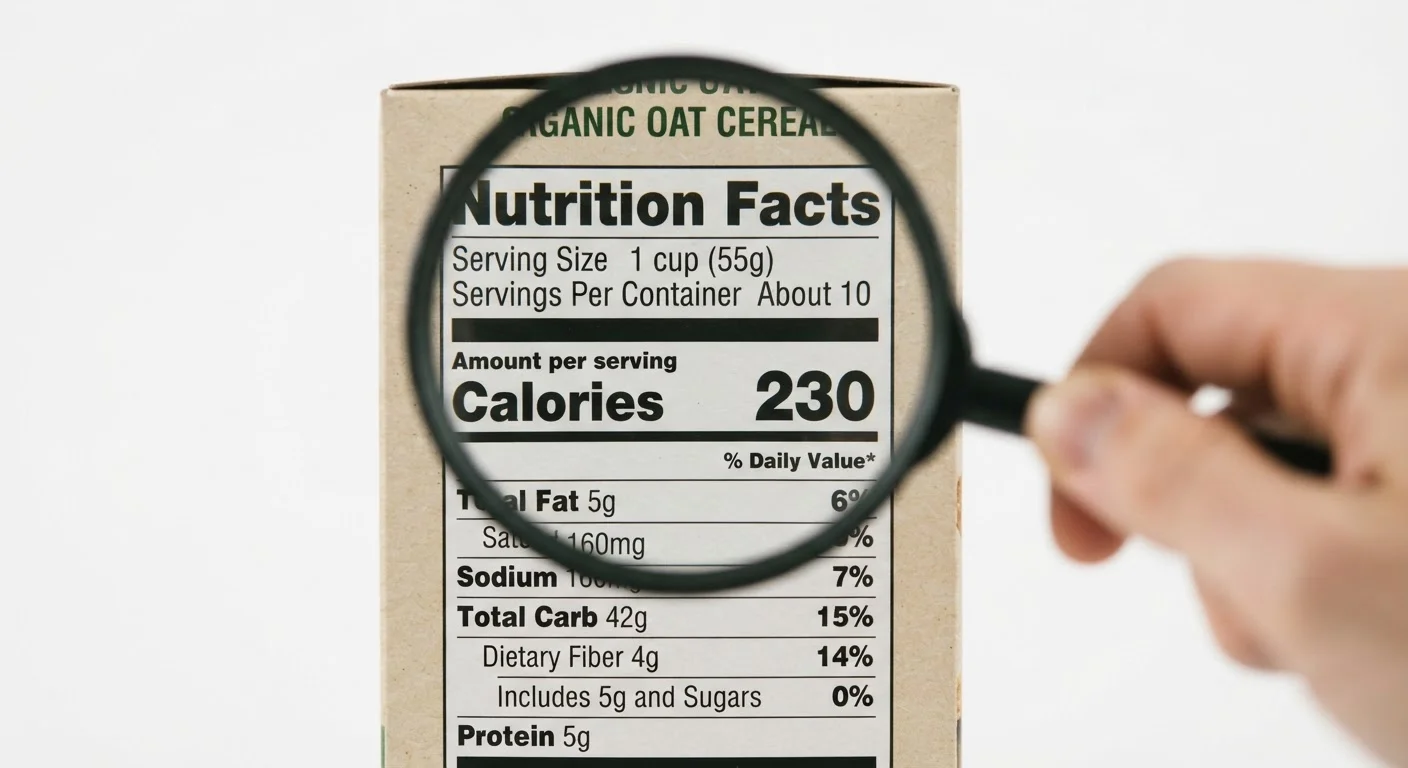
Open any bag of chips, box of crackers, or bottle of juice and the first two lines of the Nutrition Facts panel read the same way: Serving Size and Servings Per Container. They sit right next to each other, yet they answer completely different questions — and mixing them up skews every number that follows.
Serving size is a standardized reference amount established by the U.S. Food and Drug Administration (FDA). It is expressed in a common household measure — cups, tablespoons, pieces — alongside a gram weight. Critically, it is not a dietary recommendation telling you how much to eat. It is simply the unit against which all other label values are calculated.
Servings per container is exactly what it sounds like: how many of those reference units fit inside the entire package. A container showing "Serving Size: 1 cup" and "Servings Per Container: 2.5" contains two and a half cups of food. Every calorie, gram of fat, and milligram of sodium listed applies only to that one cup — not to the whole thing.
For a deeper look at how the full Nutrition Facts panel is structured, see what nutrition labels are actually telling you.
| Criterion | Serving Size | Servings Per Container |
|---|---|---|
| What it tells you | The reference unit for all label numbers | How many units are in the whole package |
| Set by | FDA reference amounts (updated 2020) | Derived from package volume and serving size |
| Is it a portion recommendation? | No — it's a standardized measure | No — it's a count of units |
| What happens if you ignore it | You compare products on unequal terms | You undercount calories, sodium, and sugar |
| Format on label | Household measure + gram weight | Single number (e.g., "About 2.5") |
| Key action required | Equalize before comparing two products | Multiply by how much of the package you eat |
Why This Confusion Matters More Than You Think
Here is where the math goes quietly wrong for most shoppers. Imagine a bottle of iced tea labeled 90 calories per serving with 2.5 servings per container. A reasonable person who drinks the whole bottle has consumed 225 calories — but if they only read the serving size line, they might log 90. That 135-calorie gap is not trivial across a day or a week.
The same arithmetic applies to sodium and added sugar, two nutrients the USDA Dietary Guidelines specifically flag as areas where Americans routinely exceed recommended limits. A can of soup might list 800 mg of sodium per serving while quietly containing 2 servings. The actual sodium load for someone who finishes the can: 1,600 mg — more than two-thirds of the 2,300 mg daily limit most adults are advised not to exceed.
2.5×
Typical gap between labeled and consumed servings
Research published in public health nutrition journals has found that consumers frequently eat two to three times the stated serving size in a single eating occasion.
2,300 mg
Daily sodium limit for most adults
According to the USDA Dietary Guidelines for Americans, most adults should consume no more than 2,300 mg of sodium per day — an amount many single-package foods can approach on their own.
2020
Year FDA updated serving size rules
The FDA's updated Nutrition Facts label rules, fully in effect by 2020 for most manufacturers, require serving sizes to reflect amounts people realistically consume rather than idealized portions.
This dynamic is not accidental. Manufacturers are not required to set serving sizes generously — they must follow FDA reference amounts, but within those standards there is still room for a serving to appear smaller than what most people eat in one sitting. The FDA updated its serving size rules in 2020 specifically to close this gap, requiring that amounts reflect what people actually consume. For example, a 12-ounce can of soda now counts as a single serving rather than being split into two. But the multiplier problem does not disappear; it just shifts.
Our intuition around portion sizes compounds this further — most people significantly underestimate how much they pour, scoop, or eat from a package without measuring.
How to Read These Two Lines Like a Pro
A few practical habits turn these two lines from a source of confusion into a genuinely useful tool.
- Check servings per container first. Before reading any other number, note how many servings are in the package and estimate how many of those you will actually eat. That ratio is your personal multiplier for every figure on the label.
- Do the full-package math when relevant. If you routinely eat a whole package in one sitting — a small bag of nuts, an individual-size yogurt, a can of soup — multiply every listed value by the servings per container to get your real numbers.
- Equalize serving sizes before comparing products. Comparing a granola with a 30g serving to one with a 55g serving produces a misleading contrast. Either calculate per-gram values or mentally scale one up to match the other. Comparing two packaged foods accurately requires this step every time.
- Use the dual-column label when it appears. Some packages now feature two columns — one per serving, one per container — which makes the full-package math visible at a glance. Seek these out; they are the clearest format available.
For a plain-language walkthrough of everything else on the panel, reading a nutrition label without getting confused is a useful next step. And if ingredient lists are your next frontier, ingredient lists follow rules most shoppers don't know about explains the ordering logic manufacturers must follow.
This article is for general informational and educational purposes only. It is not a substitute for personalized nutrition or medical advice. Consult a registered dietitian or qualified healthcare professional for guidance specific to your health needs.
The content on this site is for informational purposes only and is not a substitute for professional advice. Always consult a qualified professional for guidance specific to your situation.